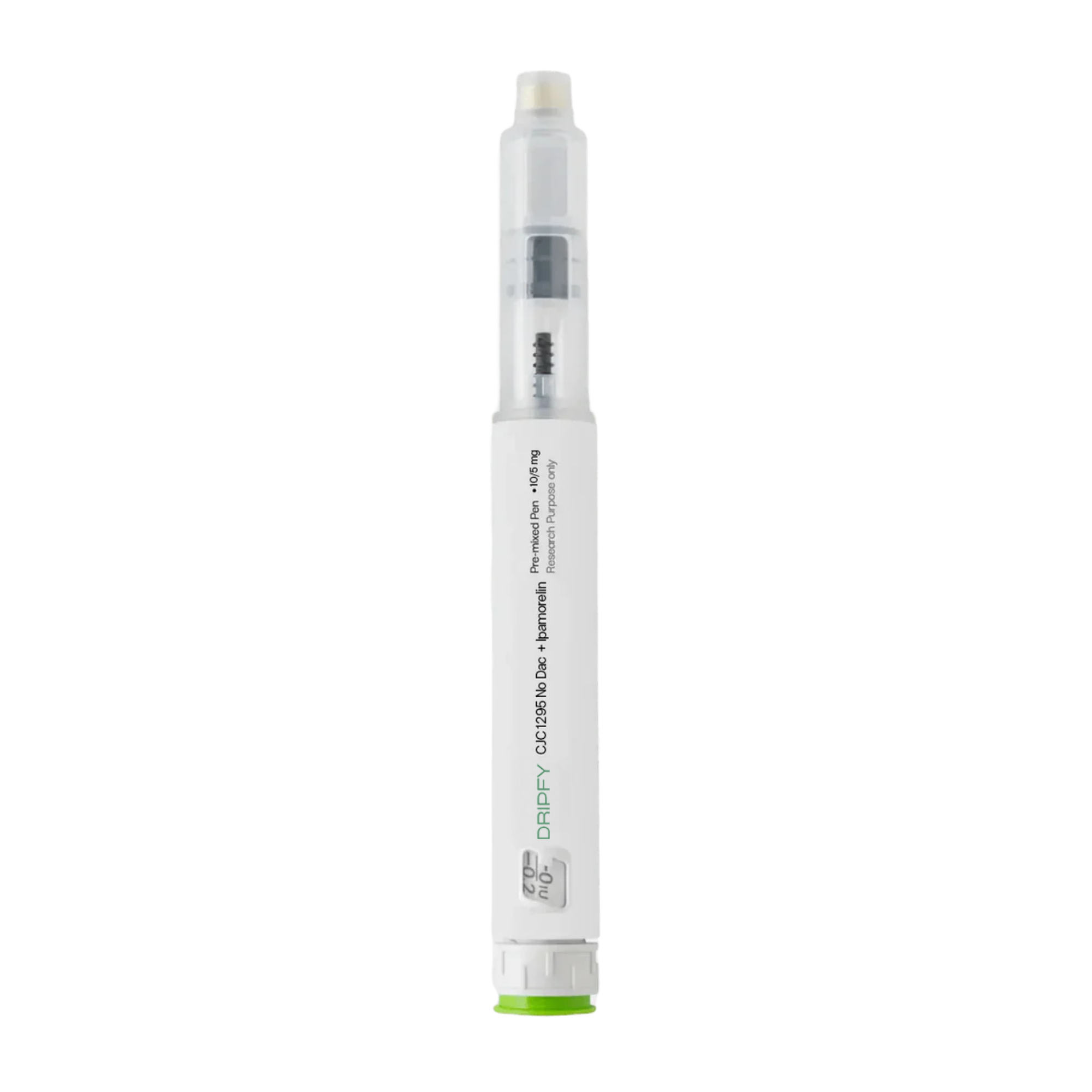

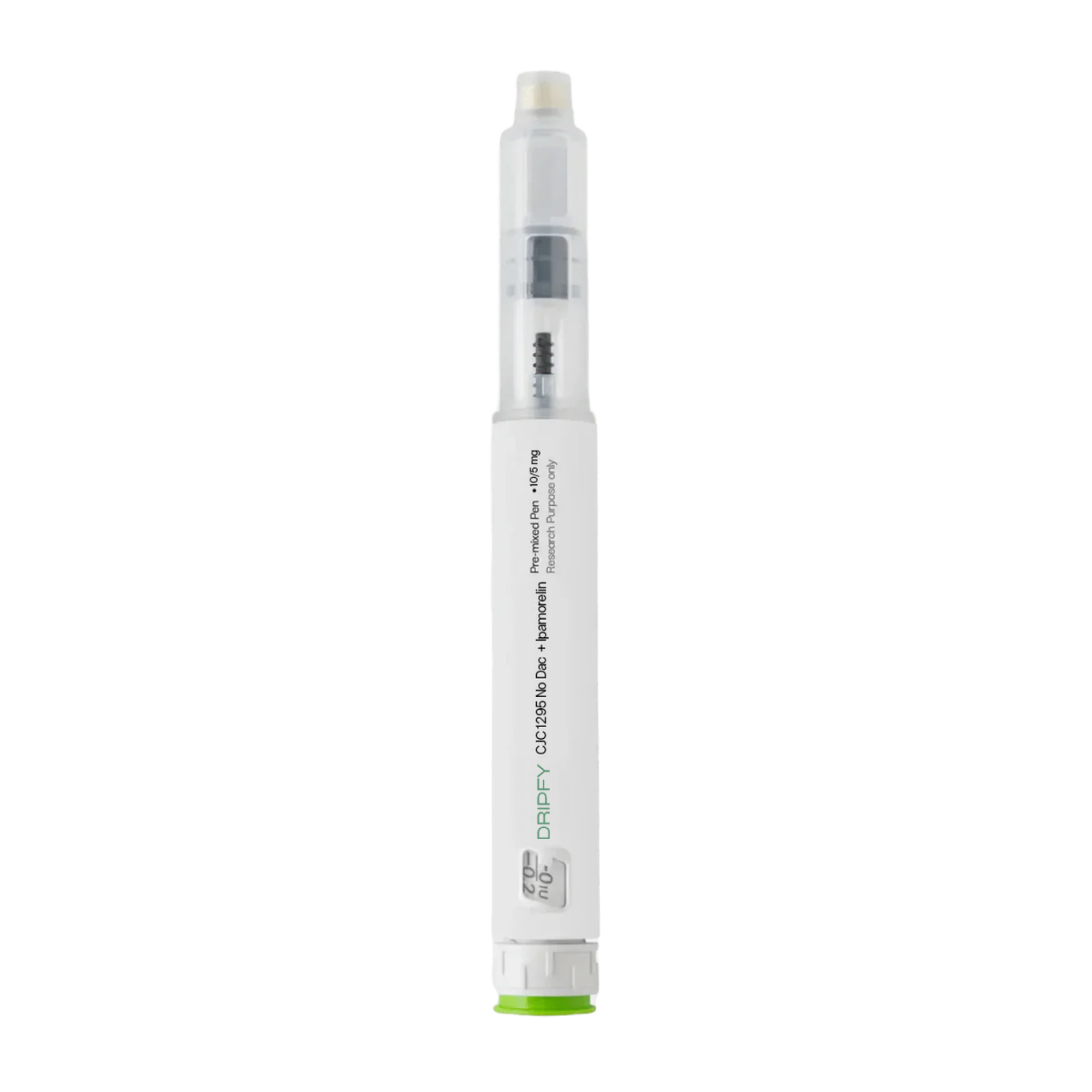
Ipamorelin / CJC-1295 (Blend)
GH-secretagogue + GHRH-analog blend (investigational) · Pre-filled pen
This blend combines two growth-hormone-axis peptides. Ipamorelin is understood to act as a selective ghrelin-mimetic secretagogue at the GHS-R1a receptor, while CJC-1295 (no DAC) is a GHRH analog understood to stimulate pituitary GHRH receptors. Combining a secretagogue with a GHRH analog is investigated on the rationale that the two pathways may act complementarily on pulsatile GH release; however, evidence for the combination specifically is very limited, and combining compounds compounds the uncertainty. Any pathway effect should be regarded as provisional.
Studied use areas
- Investigated for growth-hormone / IGF-1 axis support via two complementary pathways
- Studied within lean-mass, recovery and body-composition research
- Explored for body-composition and sleep-quality signalling
- Researched as a combined GH-axis approach rather than for any specific disease
Safety & status
- Investigational blend; combining two compounds compounds the uncertainty and the safety profile is not established
- Use only under qualified physician supervision
- Prohibited in competitive sport: listed under WADA Prohibited List class S2 (peptide hormones, growth factors, related substances and mimetics — ipamorelin and CJC-1295 are both named)
- Not for use in pregnancy or breastfeeding, or with active or suspected malignancy (GH/IGF-1 axis considerations)
⚕ Clinical note: This ipamorelin / CJC-1295 blend is an investigational, research-grade combination and not an approved medicine; blending compounds increases uncertainty and it is intended for physician-directed use only. This content is educational, not medical advice.
Evidence: Grade D — investigational; limited human data, mainly preclinical · References: Raun et al., European Journal of Endocrinology 1998; Teichman et al., Journal of Clinical Endocrinology & Metabolism 2006 (CJC-1295 with DAC — related long-acting analogue, not the no-DAC component); Dominikowski et al., Frontiers in Endocrinology 2026 (evidence review of GH-axis peptides); Sigalos & Pastuszak, Sexual Medicine Reviews 2018