
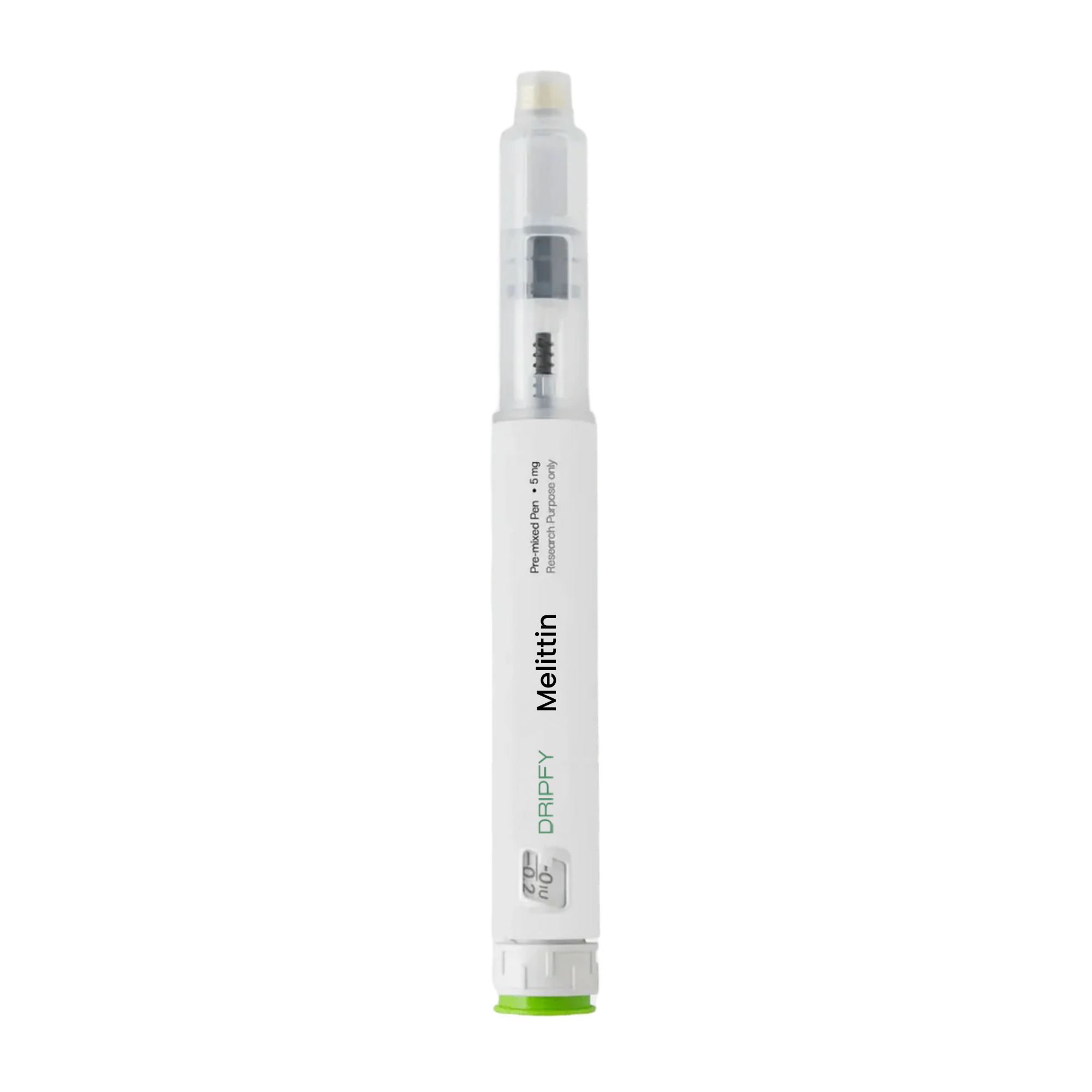
Melittin
Bee-venom cytolytic peptide (preclinical / investigational) · Pre-filled pen
Melittin is a 26-amino-acid amphipathic peptide, the principal active component of honeybee venom. It is understood to insert into cell membranes and form pores, disrupting the lipid bilayer and lysing cells through a direct biophysical mechanism rather than a defined receptor pathway, and it has been associated with phospholipase A2 activity in preclinical work. Because this membrane-active effect is non-selective, it can damage healthy as well as target cells, which is why any use is investigational and restricted to close physician supervision.
Studied use areas
- Preclinical antimicrobial membrane-disruption research
- Laboratory oncology models studied for cytolytic (cell-killing) activity
- Anti-inflammatory signalling examined in early/preclinical work
- Research tool for peptide-delivery and nanoparticle formulation studies
Safety & status
- Investigational and cytotoxic — melittin lyses cells non-selectively and can damage healthy tissue; robust human safety data do not exist
- Can trigger hypersensitivity and allergic reactions, up to anaphylaxis in venom-sensitised individuals; use only under physician supervision
- Not for use in pregnancy or breastfeeding, or by anyone with bee-venom allergy; no established human use
⚕ Clinical note: This is educational information, not medical advice. Melittin is an investigational, cytotoxic research-grade peptide with no established human therapy; it should never be self-administered and any use must occur under qualified physician supervision.
Evidence: Grade D — no human data; preclinical only · References: Raghuraman H, Chattopadhyay A, Bioscience Reports, 2007; Rady I et al., Cancer Letters, 2017; Memariani H et al., Applied Microbiology and Biotechnology, 2019